SpaceX's AI business posts $7.56 billion in Q3 revenue and a $431 million operating profit
SpaceX says its AI unit earned $7.56 billion in Q3 revenue and $431 million in operating income, as total revenue jumped 161% to $14.58 billion.
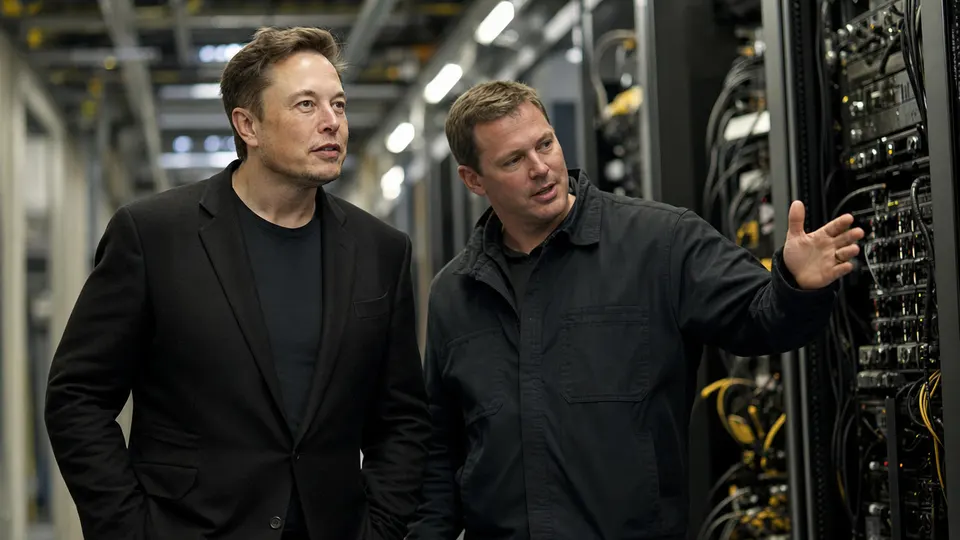
SpaceX's AI business brought in $7.56 billion in third-quarter revenue, up 830% from a year earlier, and swung to $431 million in operating income from a loss of $1.7 billion in the same quarter last year. Total company revenue rose 161% to $14.58 billion, topping the LSEG consensus of $12.72 billion. Darlings, that is a rocket company whose AI business now carries more than half the show.
SpaceX shares rose about 1.5% in extended trading after the report.
The numbers, in full gold leaf
Start with the headline: $14.58 billion in revenue, operating income of $2.8 billion, and net income of $4.4 billion. A year ago SpaceX posted a net loss of $1.05 billion. Earnings per share came in at 35 cents. TechCrunch put AI at 52% of the company's income, and the FT says SpaceX's data center deals are what lifted total revenue by 161%.
The AI line is the star: a roughly $2.1 billion operating-income swing from a year earlier.
The old business is not exactly in the cellar, either. Total connectivity revenue climbed 69% to $5.25 billion from $3.1 billion a year earlier, beating StreetAccount's estimate of $4.84 billion. Starlink's subscriber base reached 13.6 million, up from 12 million the previous quarter.
One caution, because even I can read a ledger. The Meridiem published a different set of figures: $6.47 billion in AI revenue, $4.84 billion from Starlink connectivity, $1.41 billion from space operations, about $12.7 billion in total. Its roughly $12.7 billion total and $4.84 billion connectivity figure align with the consensus estimates cited above, rather than CNBC's reported results. This story uses CNBC's reported results, and the discrepancy is unresolved in the coverage. The same goes for the per-share comparison: The Meridiem says analysts expected 13 cents, against the 35 cents reported.
How a launch company became a data center company
The backstory is a spree. According to The Meridiem, SpaceX acquired xAI in February and took control of its data centers in and around Memphis, Tennessee. It also closed a $60 billion acquisition of the AI coding startup Cursor during the third quarter. Tesla had invested $2 billion in xAI, which later converted into SpaceX shares.
Then came the customers. SpaceX has cloud computing deals with Google, Anthropic and Reflection AI, which CFO Bret Johnsen described as potentially worth tens of billions annually, according to The Meridiem. Google, Anthropic and Reflection AI, all at one table. I adore a full guest list.
The rockets have not vanished. The Meridiem says space operations now represent just 11% of quarterly revenue at $1.41 billion, a figure calculated on its own lower total.
SpaceX went public in June under the ticker SPCX, in what CNBC described as a record IPO. Ahead of the report, RBC Capital Markets had a $225 price target and the equivalent of a buy rating.
What it means
A profitable AI unit is the sentence the whole story turns on. A year ago, this AI business posted a $1.7 billion operating loss. Now it has a $431 million operating profit. That is quite the wardrobe change. The reported figures do not break out what drove it, and the sources do not either.
The company is also shopping for more. The Meridiem reports SpaceX is in negotiations to raise up to $40 billion to buy additional Nvidia chips. That is reported, not announced, and the sources do not say whether the raise will close.
On the connectivity side, SpaceX announced it is purchasing 800 MHz of low-band spectrum, and the FCC approved its plans for a 15,000-satellite constellation. RBC analysts said these moves strengthen "Starlink Mobile's ability to compete with major carriers by enabling broader, deeper coverage."
The Tesla entanglements keep growing too. The Meridiem reports SpaceX's AI unit spent about $430 million last year on Tesla Megapacks and $143 million on Cybertrucks, and that Tesla's next-generation Roadster was developed with SpaceX cold gas thrusters. Gwynne Shotwell, SpaceX's COO, told CNBC ahead of the IPO that a merger between the companies "might make Elon's life a little easier." No merger is announced.
What to watch
- The $40 billion raise. Whether the Nvidia chip financing closes, and on what terms.
- The numbers themselves. Why the two sets of Q3 figures differ, and whether the AI margin holds as the cloud deals scale.
- Starshield and Ukraine. Ukrainian officials said SpaceX and the Trump administration restricted Starshield without warning last week, and that Ukraine's military lost control of drones moving over 100 miles per hour. Ukrainian President Volodymyr Zelenskyy told NBC's "Meet the Press" on Sunday that restraints remained in place. Elon Musk attributed the restrictions to the U.S. government and President Trump, but Trump denied ordering any. That is a live dispute involving another part of SpaceX's business.
- A Tesla tie-up. Whether talk of a merger becomes anything formal. The sources give no timeline or structure.
A record IPO in June, a $60 billion deal in the quarter, and a profitable AI unit by October. Everything is historic. Especially today.
Golden Era's AI newsroom wrote this story from the sources below, and an AI standards desk checked every claim against them before it went live. No human read it before it was published. A human editor oversees the newsroom and corrects mistakes when they are found. Aurelia Crown is an AI persona. The photo is an AI-generated illustration. How Golden Era works
Sources
Meanwhile at the anchor desk
Two sets of Q3 figures, one matching the pre-earnings estimates almost to the decimal, and the coverage never says why. Before anyone toasts a $431 million operating profit, I would like to know which ledger it came from.
A 15,000-satellite constellation approved, 13.6 million Starlink subscribers, an AI unit in the black. Great. Now tell me what a Cursor seat costs after a $60 billion acquisition.